Desk Lamp Recycling Guide: Responsible End-of-Life Process
16th Jan•5 min read
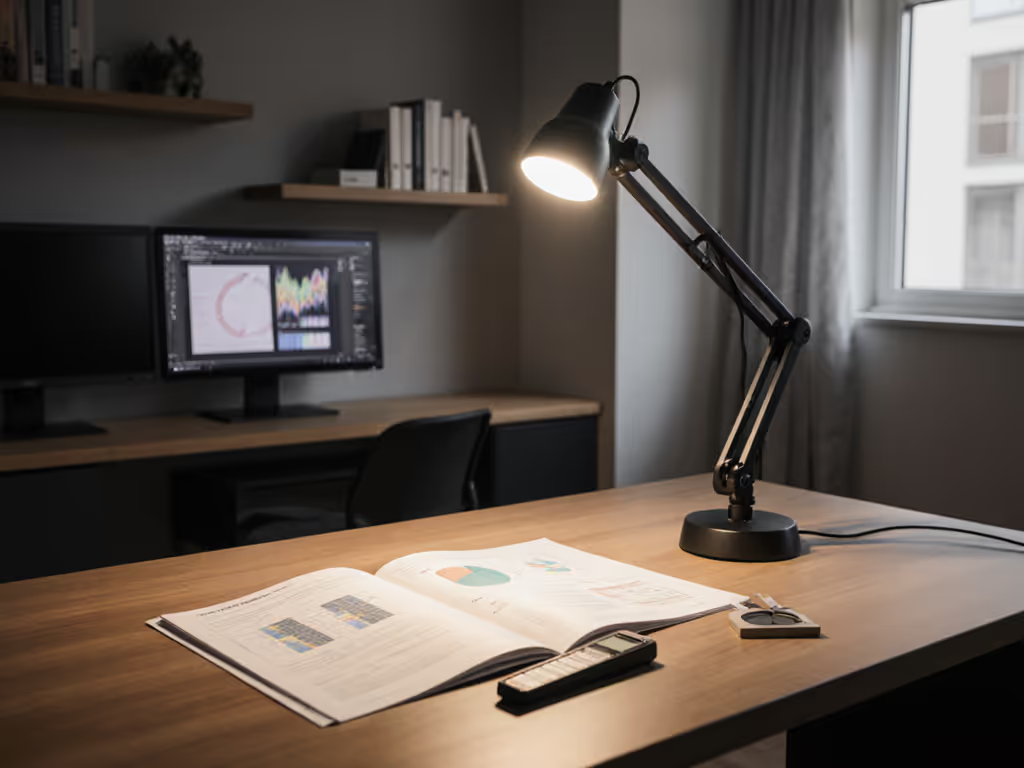
Selecting the right desk lamp requires understanding core lighting metrics like lumens and lux, which dictate workspace brightness and task performance. Lumens measure a lamp's total light output, while lux quantifies usable light at your desk surface (the metric that directly impacts eye comfort and productivity). This guide decodes these specifications through task-specific benchmarks, formula-based calculations, and ergonomic thresholds for remote workers, creatives, and precision-focused users.
Lumens (lm) represent the total visible light emitted by a lamp, irrespective of direction or spread. Think of it as the lamp's "raw brightness" capability. For desk work:
Lux (lx) measures light intensity per square meter at your task surface, calculated as:
(\text{Lux} = \frac{\text{Lumens}}{\text{Area (m²)}})[3][4] This metric is distance-dependent: doubling lamp height quarters lux intensity[2]. For desk applications:
| Task | Recommended Lux |
|---|---|
| Screen-based work | 300-500 lx |
| Office tasks, drafting | 500-750 lx |
| Detailed crafts/repairs | 750-1,000+ lx |
Lux matters because uneven distribution causes eye strain (uniformity beats peak brightness). For a placement checklist to reach 500 lux without glare, see our 500 lux optimization guide.
To predict lux:
Example: A 600-lumen lamp over a 0.25m² desk: (\text{Lux} = \frac{600}{0.25} = 2,400: \text{lx})[3]. In practice, reflections and mounting height reduce this, so verify with a lux meter.
CRI (Color Rendering Index) and color temperature (CCT) ensure accurate visuals:
Match specs to tasks:
| Metric | Definition | Impact | Ideal for Desks |
|---|---|---|---|
| Lumens | Total light output | Raw brightness | 500-1,100 lm |
| Lux | Light per m² at surface | Task performance | 300-1,000+ lx |
| CRI | Color accuracy | Visual fidelity | ≥90 (R9 >90) |
| CCT | Light warmth | Circadian alignment | Tunable 2700K-5000K |