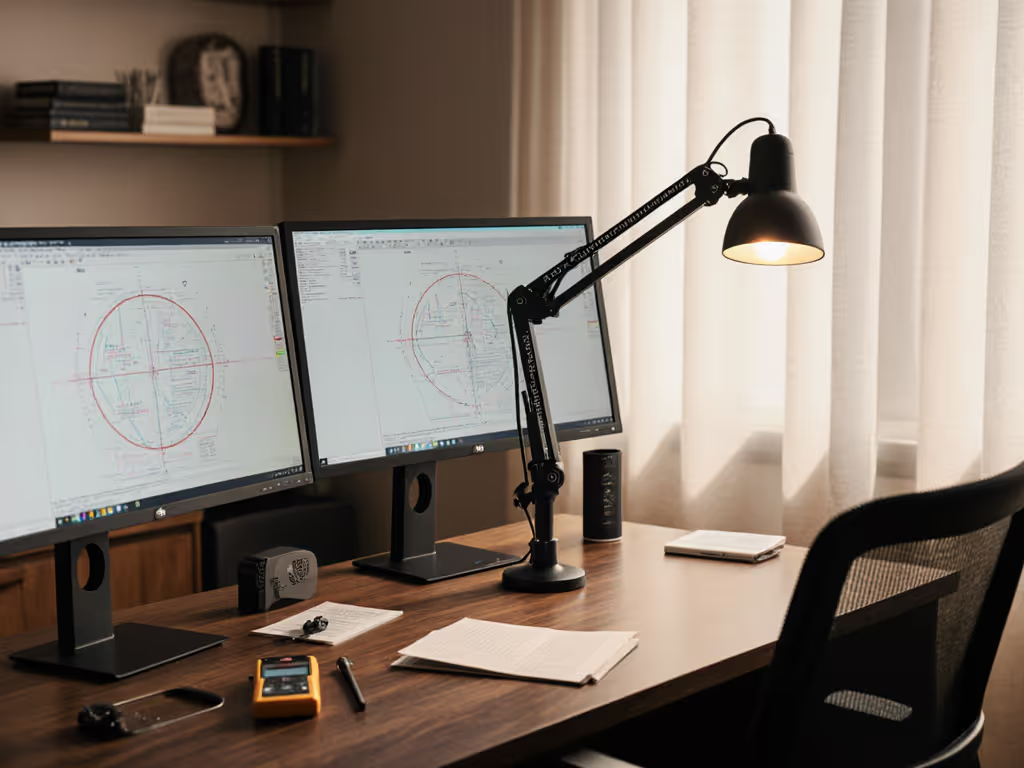
Dual-Monitor Desk Lighting: Match Beam to Screen Size
15th Mar•13 min read
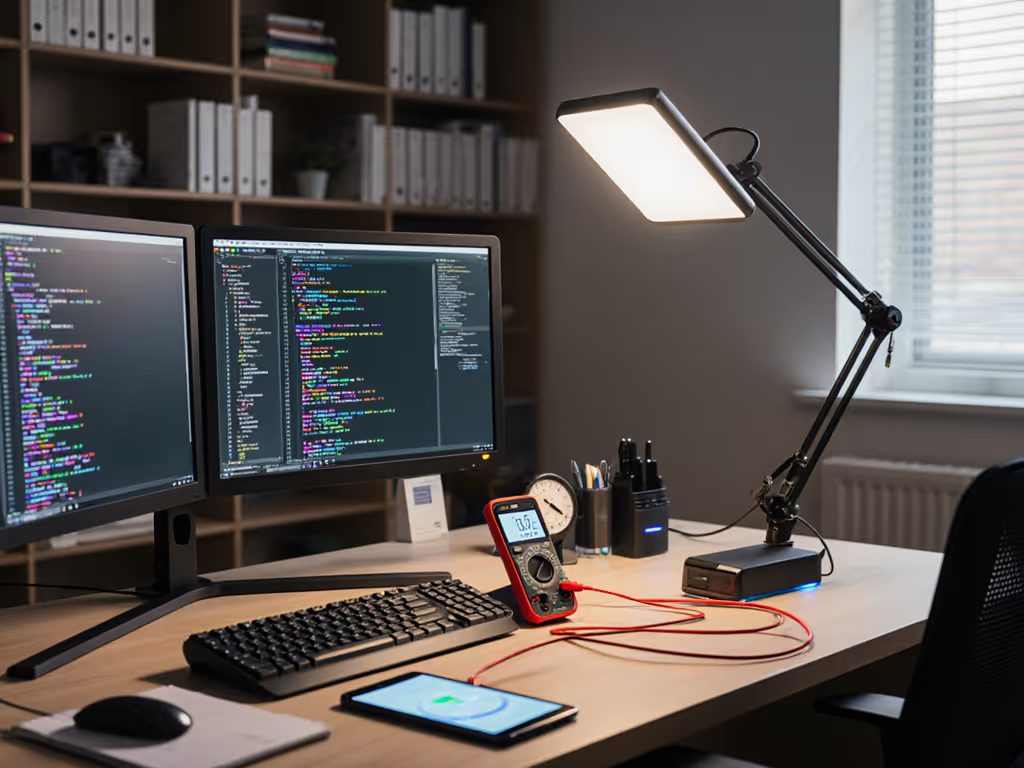
When your workspace isn't tethered to a wall outlet, desk lamps with power banks become more than a convenience; they become a problem-solver. Whether you're in a dorm with limited outlets, running between office and kitchen table, or simply tired of wrestling cables, integrating mobile workspace lighting into your setup changes how you work. But the market has evolved fast, and the options aren't created equal. This guide cuts through marketing claims and maps real performance data (battery capacity, charging speed, light quality, runtime) so you can match a lamp to your workstyle and space constraints.
Traditional corded desk lamps lock you into one spot. If you're weighing portability tradeoffs, see our comparison of cordless vs wired desk lamps. A lamp with a built-in power bank or USB-C charging inverts that logic: the light travels with you, and the battery means you're not tethered to an outlet during the work session. That freedom reshapes how remote workers, students, and creatives set up their environments.
But "power bank desk lamp" covers a wide range of performance. Some deliver only 6 hours of usable light at practical brightness; others hit 12+ hours of consistent output without visible flicker or color shift. The gap matters when you're logging a full day at a small desk, or when you're sharing a workspace and can't afford midday dimming.
The framework is simple: map your actual workstyle and desk constraints first, then dial the metrics that matter (lumens delivered at your work distance, color rendering, dimming smoothness, and runtime). Start simple: map your workstyle, then dial lux and CCT. For color temperature basics and when to use warm vs cool settings, read our Kelvin guide. One change at a time.
Before the ranked list, it helps to decode what the manufacturers and reviewers are actually measuring.
Battery Life (Runtime): Stated in hours at a reference brightness, typically 50% or full brightness. Real-world runtime depends on how much you dim; a lamp with a 12-hour rating at full brightness might deliver 20+ hours at reading brightness (a lower lux level). The sweet spot for most desk workers is 10-13 hours at a practical mid-range setting.
CRI (Color Rendering Index): A scale from 0-100 measuring how accurately a light source shows colors compared to sunlight. CRI 90+ is essential if you edit photos, paint models, or need accurate fabric/paint colors. CRI 85-89 is acceptable for general reading and screen work but won't please designers.
Flicker Metrics: Modern LEDs don't actually flicker at mains frequency (50/60 Hz) like old bulbs, but PWM (pulse-width modulation) dimming can introduce imperceptible flicker that causes eye strain and headaches for some users. Flicker rate should exceed 3 kHz to be genuinely invisible; frequency modulation (DC dimming) is even safer. Reputable reviews measure this with specialized instruments. For a deeper dive into drivers and why PWM vs constant-current matters, see LED driver tech and flicker.
Charging Speed: USB-C fast charging under 90 minutes is realistic; anything longer trades convenience for battery longevity. Most modern mobile workspace lamps hit 60-110 minutes for a full charge.
Light Output (Lumens & Lux): Lumens measure total light energy; lux measures illuminance at a specific distance (lumens per square meter). For desk work, aim for 300-500 lux for casual screen work and 750-1,000+ lux for detailed reading, drafting, or color work. Most claims are measured at 1 meter; verify specs at your actual desk distance (typically 30-50 cm).
These lamps are engineered for all-day comfort and color accuracy. They're pricier but built for professionals, creatives, and anyone doing extended color-critical work.
What to expect: A lamp in this tier delivers flicker rates below 2%, CRI 95 or higher (with excellent red saturation), 12+ hours at moderate brightness, and fast 60-85 minute charging. Expect premium materials, stable joints, and intuitive dimming.
According to a 2026 data-driven review of rechargeable table lamps, models in this class prioritize German-engineered thermal management to sustain consistent light output during long sessions without LED degradation. Dimming precision and color consistency across a wide range (2700K-5000K) separate leaders from the field.
Real-world fit: Professional photographers retouching on the road; remote designers working from varied locations; students with late-night study marathons; anyone in a shared workspace who can't rely on overhead lighting.
One change at a time: If you're upgrading from a cheap clip lamp, the difference in eye comfort alone justifies the jump. You'll notice less rubbing your eyes after a 2-hour session.
This tier delivers genuine all-day performance and excellent color accuracy without premium pricing. It's the practical choice for knowledge workers, students, and hobbyists who want measurable comfort and don't need museum-grade color science.
What to expect: A lamp here holds brightness for 10-12 hours at practical desk settings, hits CRI 92-94 (satisfying for most creative work and definitely adequate for reading and screen tasks), charges in 70-90 minutes, and offers fine-grained dimming (ideally 256+ steps or analog) with negligible flicker.
In 2026 testing, lamps with superior dimming precision and wide color temperature range (2700K-5000K) in this category achieved 12.2-hour battery life with flicker rates around 1.2%, delivering exceptional value. Models with best-value smart integration combined 10.3-hour runtime with full smart features.
Real-world fit: Remote knowledge workers alternating between screen and paper; students prepping notes and essays; hobbyists painting figures or prototyping; small business owners outfitting a home office; anyone wanting reliability without obsessive tuning.
The practical win: This is where most busy professionals land. The lamp is smart enough to adapt to your day (morning screen work, afternoon deep reading, evening winding down) but simple enough that you don't fumble controls during a call.
Designed for hot-desking, dorm life, and creative professionals who move between studio, office, and café. If foldability is a priority, compare options in our foldable desk lamp face-off. Portability doesn't mean dimmed performance. These are full featured in a tighter package.
What to expect: A lamp here weighs under 800 grams (1.75 lbs), collapses or swivels into a small profile, features a magnetic base for attachment to metal surfaces, and still delivers 11+ hours of practical brightness. CRI is typically 92+ and flicker control is solid.
Portability leaders in recent testing leverage unmatched design: magnetic bases that grip metal surfaces (monitor arms, desk clips, metal shelves) without consuming surface real estate, coupled with 11.5-hour battery life.
Real-world fit: Student shuttling between dorm, library, and home; remote workers splitting time between office and home; creative professionals (animators, architects, illustrators) moving between sites; anyone in a shared or multi-workspace setup where desk ownership is temporary.
Why it matters: A truly portable lamp doesn't force you to choose between convenience and comfort. You're not downgrading light quality to stay mobile.
For budget-conscious buyers, students, or anyone equipping multiple desks, these lamps deliver honest all-day use without frills. They're not disappointing, they're honest.
What to expect: A lamp here is straightforward: it lights your desk adequately for 9-10 hours, dims smoothly, charges in 75-110 minutes, and won't distract you with flicker or poor color rendering. CRI sits at 88-91 (good enough for reading, screen work, and casual creative projects). Design is minimal but functional.
Budget options that still deliver full smart integration (auto-shutoff, ambient light sensing) combined 10.3-hour runtime with exceptional value. Reliability and simplicity for everyday use in this segment achieved 9.2-hour battery life and flicker control suitable for general workspace use.
Real-world fit: Students on tight budgets; professionals outfitting a secondary desk; anyone testing the power-bank-lamp concept before investing in premium gear; small teams standardizing affordable lighting across open offices.
Honest assessment: These aren't compromises if your work is primarily screen-based or general reading. They become compromises only if you're color-grading video or painting at night shift and expecting museum-grade rendering.
For users whose work depends on seeing color and light accurately (photographers, videographers, model painters, textile designers, retouchers), this tier removes doubt.
What to expect: A lamp here achieves CRI 97 (the highest among practical desk lamps), flicker rates below 1%, and often features optimized beam patterns (asymmetrical or diffused) to avoid glare on computer screens while delivering even coverage on physical work. Runtime is often 8-10 hours (trading some battery for thermal headroom needed for premium LED tuning and color accuracy).
Color accuracy leaders in recent data achieved CRI of 97 with flicker rates as low as 0.6%, making them the gold standard for color-critical tasks like art direction and design.
Real-world fit: Photo editors and retouchers; digital painters and illustrators; jewelry makers and watchmakers; model painters and miniature enthusiasts; fabric and material selectors; anyone streaming or recording video who needs accurate skin tones and environment colors.
Why premium CRI matters: Weak reds (low R9 value) trick your eye into undersaturating warm tones. Over a 3-hour editing session, you'll recolor the entire image when viewed in daylight. Premium CRI saves you from invisible errors.
These lamps learn your routine or adjust in real-time to your screen and environment, reducing manual tweaking.
What to expect: A lamp here offers AI-driven adaptive brightness (sensors detect ambient light and task), scheduled color temperature shifts (bright cool light in morning, warm dim at evening), and task-specific presets (reading, screen work, creative mode). Integration with smart home systems (voice control, routines, circadian scheduling) is standard. We tested voice assistants and automations across ecosystems in our smart desk lamps comparison.
AI-powered adaptive brightness systems in 2026 models achieved 11-hour runtime while adjusting intelligently to user environment and task.
Real-world fit: Professionals juggling multiple tasks throughout the day (emails, deep coding, design review, casual browsing); anyone sensitive to blue light disrupting evening sleep; remote workers following a structured daily rhythm; creatives who want one lamp to adapt rather than reaching for three task-specific tools.
The practical win: Less decision fatigue. The lamp learns what "reading brightness" feels like to your eyes and replicates it automatically, day after day. One change at a time, the lamp handles the complexity.
Instead of scrolling specs, ask yourself three questions:
1. What's your real work pattern? Are you glued to a desk all day (screen and paper mixed), or do you move around (hot-desking, coworking)? Do you do color-critical work, or is your primary task reading and screen work?
2. How long is your actual work session without a power outlet? If you work 8 hours but return to an outlet for lunch, a 10-hour lamp is overkill. If you're in a dorm with one outlet and three desk spots, you need 12+ hours and portability.
3. What's your budget, and what's the dollar-per-hour cost? A $200 lamp used 4 hours/day for 5 years ($0.05/hour) is cheaper than a $60 lamp used the same way ($0.008/hour, but it fails after 2 years and you buy twice). Use realistic lifespan and daily use to compare.
Once you've answered those, match to a tier above. Tier 1 or 5 if color matters; Tier 2 or 3 if portability matters; Tier 4 if budget is the constraint; Tier 6 if you want to stop thinking about lighting and let the lamp adapt.
Manufacturer specs often measure light output at 1 meter, far from real desk distances. A lamp claiming "1000 lumens" may deliver only 200 lux at 40 cm (a typical working distance for a small desk), which is not enough for comfortable reading.
Reliable reviews measure CRI and flicker with third-party instruments (spectrophotometers and flicker analyzers), not marketing claims. Battery runtime is tested at reference brightness (not max brightness, which nobody uses all day). Charging time is measured by observation, not wishful math.
When shopping, ask:
If specs don't answer those questions, the vendor is hiding something. Move on.
The best lamp isn't the most expensive one, it's the one aligned with how you actually work. A $150 lamp delivering exactly what you need beats a $300 lamp delivering features you'll never tune.
If you're migrating from a borrowed or weak light source, you'll notice the difference immediately: fewer headaches, faster reading, calmer eyes by the end of a long day. That's the real measure, not spec-sheet drama, but comfort you feel after 2 hours of work without rubbing your eyes.
Start simple, pick a tier that fits your workstyle and budget, and dial one metric at a time. The right lamp disappears into your routine; the wrong one nags at you every session. Your workspace, and your eyes, will thank you for measuring twice and buying once.