Desk Lamps With Power Banks: Tested & Ranked
27th Mar•12 min read
Choosing the right children's eye-care desk lamp means understanding what makes pediatric lighting solutions work, not what marketing copy promises. After years of testing affordable lamps on cramped desks, I've learned that the cheapest option rarely delivers where it matters: stable light, smooth dimming, and the optical precision that protects developing eyes during long study sessions. For age-appropriate picks and safety features, see our best budget kids desk lamps.
A child's visual system is still maturing. The lens is clearer, the retina more light-sensitive, and the focusing system less forgiving of poor beam quality. When light flickers, glares, or skews too blue late in the evening, young eyes pay the price: eye strain compounds into headaches, attention drifts, and sleep suffers[5]. Unlike adult eyes, which have thickened lenses that filter some harsh wavelengths, children absorb more short-wavelength light and are more vulnerable to discomfort from cheap LEDs that skip crucial tuning steps[5].
This is why safe lighting for developing eyes begins with measurable specs, not feel-good marketing. Your child's homework corner is not the place to gamble on a $15 lamp that looked good in a thumbnail photo.
The Color Rendering Index measures how accurately a light source reveals the true colors of objects under illumination. For children's eye-care desk lamps, look for CRI of 90 or higher[6]. This isn't a luxury, it's a baseline. When CRI drops below 85, reds look dull, printed text takes on unnatural casts, and the visual system works harder to interpret what it's seeing. Over hours, this fatigue accumulates.
The best pediatric models push higher: CRI 95-98 lamps exist at mid-range prices and make a tangible difference when your child is reading, sketching, or distinguishing shades during art projects[1].
Poor-quality LEDs flicker, often invisibly to conscious awareness, but not to the nervous system. When powered by cheap PWM (pulse-width modulation) drivers at low dimming frequencies, the lamp cycles on and off dozens of times per second. Children notice this as a vague discomfort; sensitive kids report headaches within 30 minutes[5].
Child-friendly flicker-free lamps use high-frequency modulation (above 3 kHz) or true DC dimming, eliminating perceptible flicker entirely. This is a non-negotiable feature for after-school study sessions and evening reading. Learn how driver design impacts flicker in our LED driver guide.
Blue light protection for children isn't about blocking all blue light, the visual system needs it during the day. The issue arises at night. Cool-white LEDs (5000K and above) spike in the blue wavelengths that suppress melatonin production and disrupt sleep onset[5]. If homework happens after 5 PM, a lamp with warm-dim capability (3000K or dimmer to 2700K) or selectable color temperatures becomes essential. For choosing the right color temperature by task and time, see our Kelvin guide.
Children who study under cool-white lamps at 8 PM and then struggle to fall asleep at 10 PM aren't lazy or wired, they're experiencing acute circadian disruption. Warm-dim lamps sidestep this entirely.
Before picking any lamp, identify your desk's real estate and your child's workflow:
After returning three 'deal' lamps that drooped, buzzed, or drifted during use, I spent a weekend shimming joints and measuring flicker alongside my kid's homework. The cheapest winner wasn't the brightest, it held position, dimmed smoothly, and kept flicker imperceptible. That lamp paid for itself in calmer evenings and fewer returns.
When evaluating a lamp:
Value is lumen control, not coupons: right light, right task. Here's what mid-range, durable models deliver for pediatric study spaces:
Lamps with CRI 90+ and adjustable height (40-60 cm) suit mixed study tasks, reading, writing, and screen time. The tall arm clears monitors and drawing pads. Honeywell Sunturalux Foldable Modern Desk Lamp exemplifies this tier: $40, compact base, adjustable brightness and color temperatures, and LED bulbs rated for over 50,000 hours[3]. It's not a luxury pick, but it's engineered without obvious weak points.
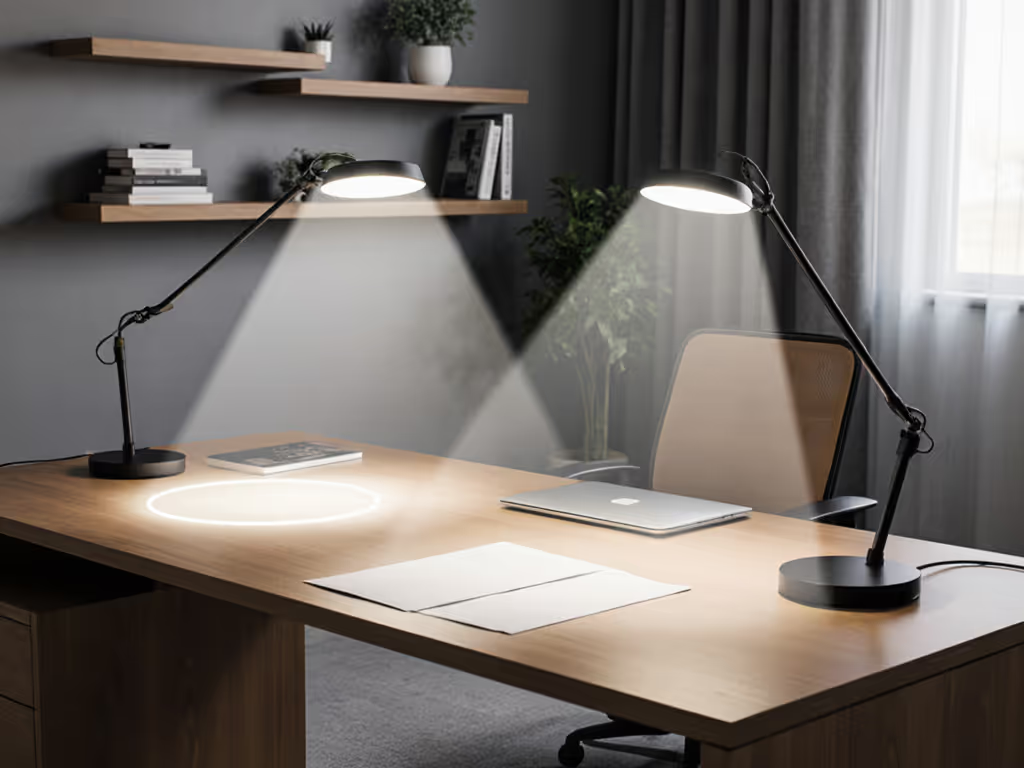
Budget lamps often concentrate light in a narrow cone, creating bright spots and dark shadows. Better models use diffusion and reflector geometry to spread light across a 40-50 cm zone at the desk surface, no harsh hot spot, no deep shadows[3]. This matters because shadowing forces your child to tilt or crane their neck, compounding strain.
Cheap lamps offer coarse dimming (three or four steps) and forget your last setting each time you turn them on. Mid-range models provide smooth, continuous dimming and memory: turn it off at 60%, turn it back on at 60%. This eliminates fiddling and makes task-switching seamless.
This is where many mid-range lamps fail. They pass flicker tests at full brightness but flicker noticeably when dimmed to 20-30%. Quality models maintain high-frequency modulation (or DC) across the entire dimming range. When you're unsure, look for independent test certifications or review discussions about dimming comfort.
Assuming brighter is safer. High lux (over 1000) in a bedroom or evening study space will suppress melatonin and cause discomfort. Aim for 300-500 lux for screen work, 500-750 lux for reading and writing, and dial back warm-dim versions for evening sessions after 6 PM. Our step-by-step 500 lux setup guide shows how to measure and hit these targets.
Ignoring color shift. Some lamps shift from cool white (5000K) at full brightness to yellowish-green at low brightness due to poor LED binning and driver design. This isn't just ugly, it's disorienting. Test dimming in-store if possible, or read detailed user reviews specifically mentioning dimming behavior.
Choosing portable over stable. A lamp that sags, droops, or requires resetting after a gentle bump wastes focus and compounds frustration. Stability is worth the $15-20 premium over a lighter, wobblier design.
Overlooking blue light at night. If homework regularly happens after 6 PM, a warm-dim or tunable-white lamp is not optional, it's orthopedic lighting. Cool-white-only lamps will disrupt sleep onset for sensitive children.
Children's eye-care desk lamps succeed when they combine three ingredients: measurable optical quality (CRI 90+, high-frequency flicker suppression), ergonomic durability (stable joints, smooth dimming, quiet operation), and task-appropriate dimming (warm-dim for evening, adjustable reach for mixed use).
Return-proof picks share a pattern: they cost $40-90, carry mid-tier brands with real warranty support, and prioritize invisible reliability over flashy features. A $50 lamp with stable joints and genuine flicker-free dimming will outlast two $25 impulse buys and save your child's eyes, and your evening sanity, in the bargain.
Start with your constraints: desk size, task mix, and budget. Verify CRI in the spec sheet (not just the product title). Ask or research whether dimming is smooth and flicker-free at 20% brightness. Check return policies; a 30-day trial costs you nothing and reveals flicker, beam quality, and joint durability under real homework load.
The best lamp isn't the brightest or cheapest, it's the one that holds position, dims predictably, and keeps your child's developing eyes comfortable for years. That's the lamp worth buying.
Return-proof picks balance precise, controllable light with durability: the lamp that holds its adjustment, dims without buzz or flicker, and earns its place on your child's desk through season after season of homework.