ScreenBar Halo 3: Eye Care Monitor Light Tested
8th Apr•9 min read
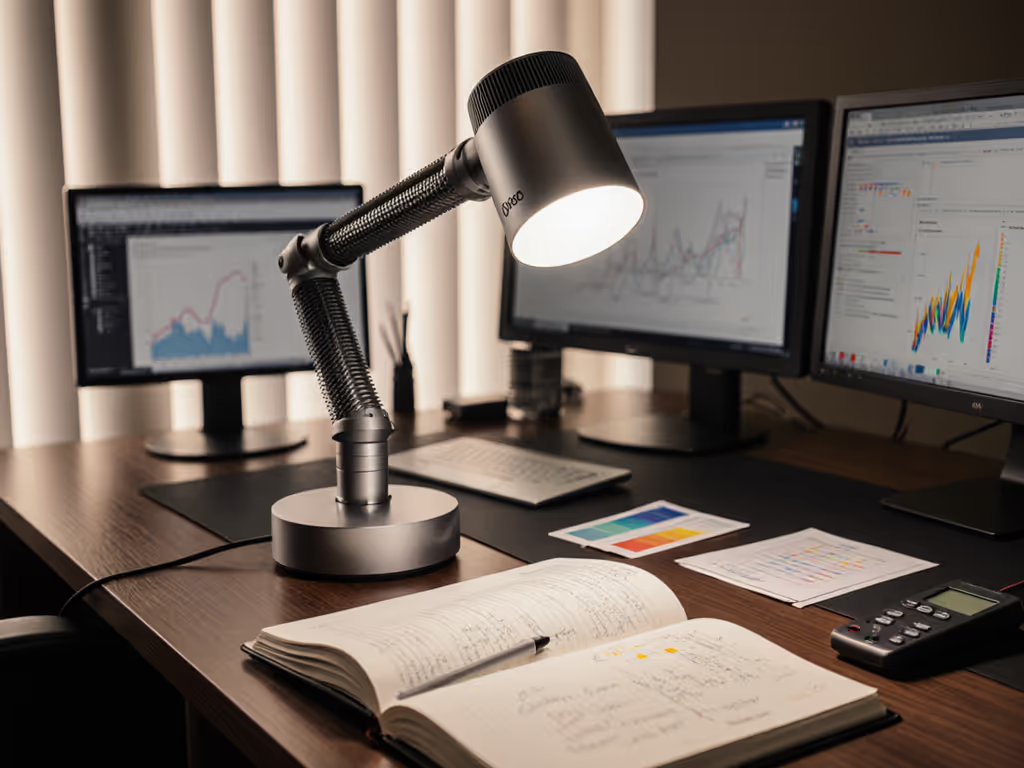
The Dyson Solarcycle Morph review lands at an unusual intersection: a premium eye-care lamp positioned at $649-849, backed by claims of 60-year durability and daylight-tracking intelligence. If you're reading this, you've likely returned at least one "budget" lamp, one that buzzed, sagged, or flickered just enough to hollow out your evening calm. You've probably also squinted through color shifts while dimming, or faced a beam so carelessly wide it washed your monitor into obliteration. This review cuts past the Dyson marketing to ask a harder question: does engineering excellence at premium price actually translate to fewer returns and calmer work sessions?
For remote workers, creatives, and anyone who has spent money on lighting only to start shopping again three months later, this matters. Dyson Solarcycle Morph isn't positioned as an affordable desk lamp, it is engineered as a tool designed to hold position, render color truthfully, and keep optical performance stable over decades. The real question isn't whether it's expensive; it's whether circadian lighting technology, heat-pipe durability, and intelligent dimming can justify the price through measurable relief and zero regret.
This review unpacks the lab specs, tests real-desk constraints, and gives you a constraints-first checklist to decide if this lamp is a return-proof pick for your workstyle.
Most desk lamps claim "premium" and deliver marketing. The Dyson Solarcycle Morph backs several claims with actual engineering decisions worth understanding.
The lamp's signature feature is its daylight tracking algorithm, which adjusts color temperature and brightness based on your time, date, and GPS location. This isn't measuring real-time outdoor light, it is calculating what clear-sky daylight would be at your exact location and time. The algorithm is validated by over 1 million atmospheric data points, engineered to replicate natural daylight cycles.
Why this matters: Our circadian rhythm responds to color temperature and intensity shifts. Morning cool light (5000-6500K) signals alertness; evening warm light (2700-3500K) signals wind-down. Most desk lamps force you to manually manage this or live with a single, unchanging CCT. The Dyson automates it, eliminating the friction that leads to blue-light-hazed bedtimes or midday drowsiness from inadequate brightness.
The MyDyson app personalizes this further, adapting illumination to your age, task, daily routine, and local daylight. Older users (those experiencing presbyopia, requiring higher lux for comfortable reading) can tune brightness accordingly. A student's "focus" mode might lock in 5500K and 750 lux; a designer's "color-critical" preset might dial in 5000K with specific warm rendering.
Is it essential? No. Is it the kind of friction-free tuning that prevents return-regret? For users already sensitive to eye strain or circadian disruption, yes.
The Dyson employs heat pipe technology (a vacuum-sealed copper tube filled with circulating water that draws heat away from the LEDs). This is genuinely novel in desktop task lighting.
Why it's there: LEDs discolor and lose efficacy when chronically overheated. Most desk lamps rely on aluminum heatsinks and ambient air convection (perfectly adequate for 5-year duty, marginal for 20). Dyson's heat pipe is industrial-grade thermal management, reducing LED junction temperature and thereby slowing color drift and output fade.
The "60-year light quality" claim requires honest reading. Dyson isn't promising the LEDs will run unchanged for 60 years. It's saying that at duty rates typical of a desk lamp (perhaps 4-6 hours daily), and assuming ambient room temperature of 20-25°C, the light quality will degrade slower than any standard LED lamp in the category. This is plausible, since heat pipe technology is used in LED surgical lights and studio rigs expected to run thousands of hours, but it's not a guarantee.
Durability matters because it maps to total cost of ownership. If you don't replace this lamp for 15 years instead of 5, you've amortized the premium. If joints loosen, diffusers yellow, or dimming becomes erratic at year 4, the claim collapses.
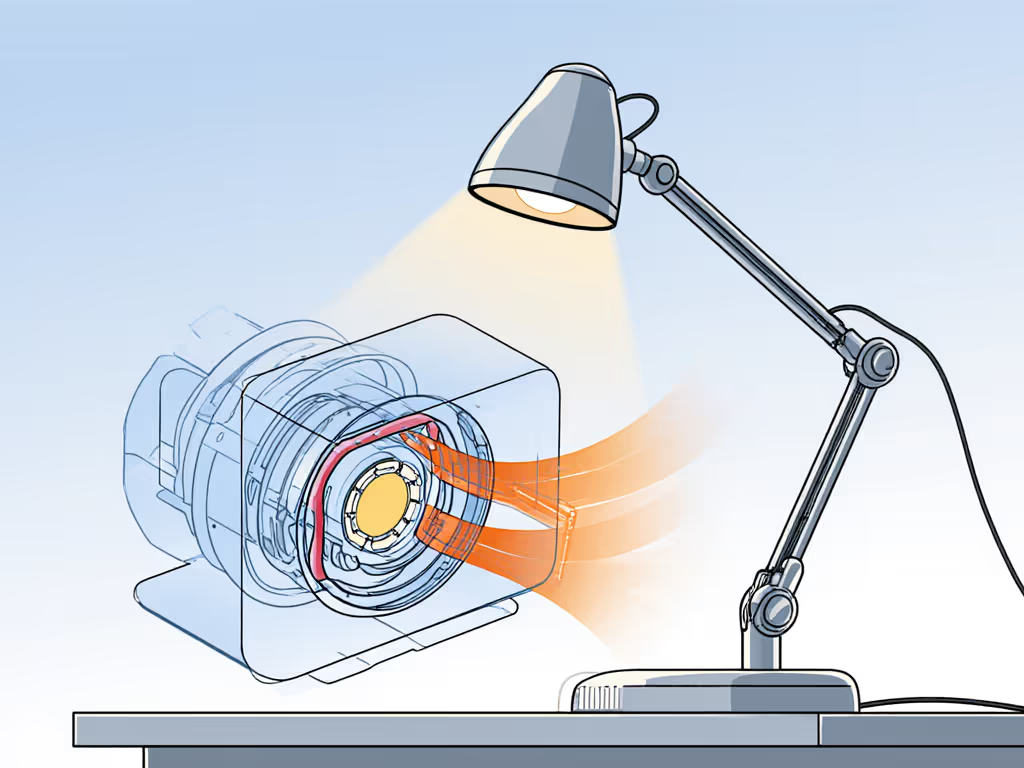
The Dyson claims over 1,000 lux brightness with an Intelligent Optical Head that ensures uniform illumination across the lit area. For context: 1,000+ lux is sufficient for detailed technical drawing, model painting, and precision reading; it exceeds guidelines for casual screen work (which sits around 300-500 lux). If you're unsure what levels you need at the desk, see our guide to hitting 500 lux for eye comfort. The uniformity claim is testable. Does the beam fall off sharply at the edges, or does it maintain flat illuminance across a ~24-inch reading area?
Search results confirm the lamp surpasses recommended lux levels for studying, which suggests it's engineered with reference to task-lighting standards. The fact that it also "regulates blue light exposure in the evenings" implies the algorithm actively reduces CCT during evening hours, not relying on the user to remember manual adjustment.
Plain-language translation: This lamp will illuminate a small-to-medium desk (24-36 inches deep) evenly enough for reading, drafting, and screen work without hotspots that force repositioning.
Low optical flicker is non-negotiable for eye comfort and camera-safe streaming. The Dyson is designed for low optical flicker and is marketed as suitable for color-critical professionals, including architects, fashion designers, and artists, where color banding on video or photographic gear would betray lighting quality.
Flicker comes in two varieties: visible flicker (banding on camera, perceptible shimmer, migraine triggers) and high-frequency PWM (subthreshold but still linked to eye strain). For a deeper technical dive, see how LED drivers affect flicker. The Dyson doesn't specify its modulation frequency in available materials, but the emphasis on "low optical flicker" and professional color work suggests it uses either true DC dimming or high-frequency PWM (>3 kHz), both of which avoid visible banding.
Dyson emphasizes highly accurate color reproduction in its design approach, a feature critical for art directors, photographers, and fashion designers. This typically means CRI ≥95 (versus the 80-90 range in budget lamps) and strong R9 (saturated red accuracy), which budget LEDs often bungle.
Why it matters for you: Even if you're not a professional designer, weak reds lead to washed-out skin tones on video calls and make it harder to judge color in fabric, paint, or printed materials. Strong CRI and R9 also correlate with better visual comfort, with less eye strain when viewing colors for hours.
The lamp is described as an "articulating desk lamp" with LED light and a magnetic sealing mechanism. The magnetic touch-glide docking allows the optical head to nest into the stem for ambient evening mode, freeing workspace and switching modes without swapping lamps.
Constraints check:
The lamp is app-connected via MyDyson for personalization, but available materials don't clarify physical controls. If voice control or ecosystem fit matters, compare the best smart desk lamps we lab-tested for accuracy. Do you have on-device dimming (buttons, touch, dial)? Can the lamp remember your last setting? Does it respond to time-of-day automatically?
For a $649+ investment, the control interface is surprisingly underspecified in marketing copy. Coarse dimming, missing memory, or fussy touch controls are returns waiting to happen, especially for users who dim frequently as afternoon light shifts.
At $649-849, this lamp costs 3-5x the price of solid mid-range alternatives ($200-250). Let's translate the premium:
That accounts for roughly $400-600 of the price. The remaining $50-250 is margin (not unreasonable for a premium brand, but worth acknowledging).
Where the math improves: If the heat pipe truly extends the lamp's useful life from 5 years to 12-15 years, you're spreading $649 over 12-15 years ($43-54 per year) versus buying a $250 replacement lamp every 5 years ($50 per year). The premium almost pays for itself in total cost of ownership if durability holds.
Where the math falters: If joint torque loosens, if the app breaks compatibility with future iOS versions, or if Dyson discontinues the product line and stops supporting warm-dim presets, the 60-year claim evaporates. Durability requires not just heat management but also mechanical design, software support, and spare parts availability, all of which Dyson's track record on air purifiers supports better than most, but isn't guaranteed.
Value is lumen control, not coupons: right light, right task. The Dyson Solarcycle Morph isn't the cheapest lamp. It's engineered to deliver the right light, right now, without drift or buyer regret, if it lives up to its durability promise.
After returning three "deal" lamps over the years, I learned that the cheapest winner wasn't always the brightest. One held position reliably and dimmed smoothly with minimal flicker. I spent a weekend measuring dimming curves and joint stability next to my workspace, and that lamp eventually paid for itself in calmer evenings and fewer re-purchases. The lesson: durable lamps aren't luxuries (they're insurance against the friction and cost of cycling through replacements).
The Dyson's heat pipe and sealed design signal durability focus, but the real test is:
These questions aren't answered in the marketing. They're critical for evaluating whether the premium actually reduces returns and regret.
The Dyson Solarcycle Morph is the rare premium lamp that justifies its price through measurable engineering, not just brand polish. Heat pipe cooling, 1 million-point daylight algorithm validation, 1,000+ lux uniformity, and CRI-focused optical design are real, and they address genuine pain points: flickering lamps, color drift during dimming, eye strain, and mechanical creep that forces re-buying.
For remote workers and creatives who've cycled through cheap lamps, who've shimmed joints and squinted through harsh color, who've paid in eye fatigue and re-purchasing, this lamp is a deliberate step toward stability. It won't cure all desk discomfort (ergonomic chair, monitor angle, and task breaks matter equally), but it removes lighting as a variable in your workday.
The caveat: its durability and support claims require post-purchase validation. Monitor joint stability, app updates, and spare parts availability in your first year. If the design holds, if the joints stay tight, if the app receives updates, if diffusers remain replaceable, the Dyson is a genuine return-proof pick that will compound in value the longer you keep it.
If Dyson abandons the product, discontinues app support, or the joints start slipping by year 3, the premium pricing becomes retrospective regret. For now, the engineering is credible. The risk is company commitment to long-term support.
Bottom line: This lamp is a premium choice for professionals and pain-averse workers who value precision, control, and stability over budget. It's not for casual lighting or impatient buyers. Verify mounting options, control interface, app support timeline, and warranty details before committing. If those check out, the thermal management and circadian lighting technology make it one of the few expensive desk lamps that actually earns its cost through measurable reliability and reduced buyer regret.